Tweet This
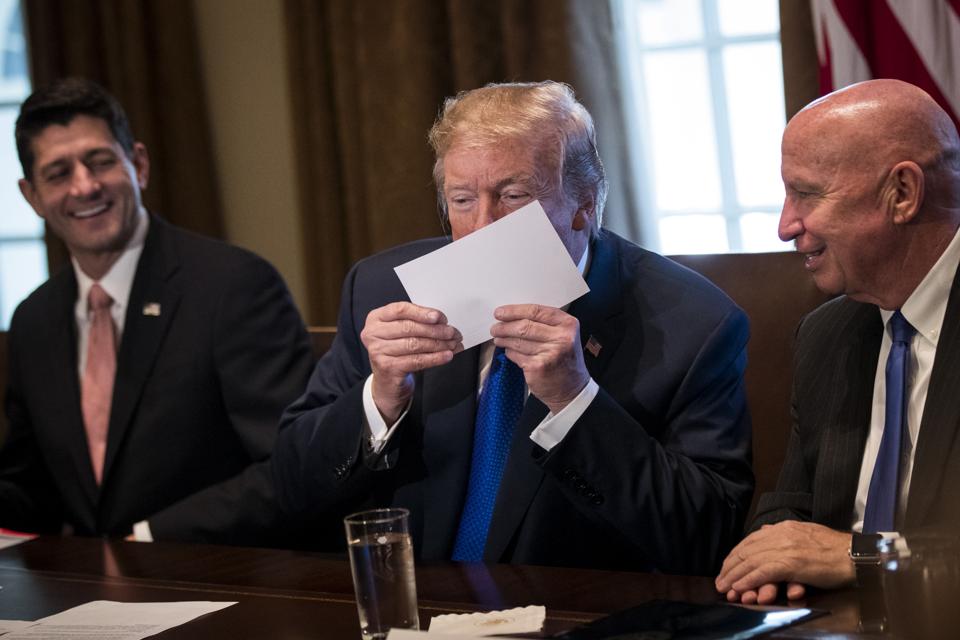
WASHINGTON, DC - NOVEMBER 02: Flanked by Speaker of the House Paul Ryan and House Ways and Means Committee chairman Rep. Kevin Brady (R-TX), President Donald Trump kisses an example of what a new tax form may look like as he speaks about tax reform legislation in the Cabinet Room at the White House, November 2, 2017 in Washington, DC. On Thursday, Republican lawmakers unveiled their plans for a massive rewrite of the U.S. tax code. (Drew Angerer/Getty Images)
The popular joke about Tesla founder and CEO Elon Musk is that every time his company reports another quarterly operational loss, he makes another high profile speech about creating a human colony on Mars. After last week, Mr. Musk may need to consider making a series of such speeches.
Not only did Tesla report another quarterly loss last week, it reported its biggest single-quarter loss since starting business in 2009. Its Q3 2017 loss of $619 million almost doubled its previous record quarterly loss, which came in Q2 2017. That second quarter loss barely exceeded the company's Q1 loss of $330 million. 2017 has not been kind to Tesla.
As if to heap insult onto injury, just a couple of days after Mr. Musk had to acknowledge his company's worst financial quarter, the Republican dominated House of Representatives unveiled its proposed major tax reform plan for both individual and corporate taxpayers. While the GOP plan does lower the corporate tax rate on corporate profits from its current 35% to 20%, that is hardly relevant to Tesla, which has never reported an annual profit in its history, and in fact has only twice reported a quarterly profit.
Making matters even worse, not just for Tesla but for all other manufacturers of electric vehicles in the U.S., the GOP tax plan proposes to repeal the existing $7500 tax credit available to purchasers of these cars. This credit, along with similar credit and rebate programs available in the various states, has enabled EVs to be at least semi-price competitive with gasoline and diesel cars. Were the credit to go away, it is very likely that sales of EVs would plummet, a reality that no amount of speeches or press releases about Mars could hope to offset.
Of course, the lobbying is just beginning related to the tax reform effort, and any final bill will likely be significantly different from the initial proposal. Regardless, it is not a promising beginning for Tesla.
U.S. shale producers, on the other hand, were no doubt quite pleased at the initial tax plan rolled out Speaker Paul Ryan and Ways and Means Committee Chairman Kevin Brady. That's because the proposal would preserve both the ability to expense Intangible Drilling Costs (IDCs) and the provision that allows mainly small producers to write off a percentage of their "inventory" of unproduced oil or natural gas each year, known in the tax code as Percentage Depletion.
This is already being portrayed by some in the national news media as a giveaway to "big oil", but that is a complete mis-characterization. As I pointed out in a piece for Forbes back in 2013, both Percentage Depletion and IDCs are longstanding features of the federal tax code, having been first enacted into law in 1913, more than a century ago. Referring to either as a "giveaway" in 2017 is simply dishonest.
">WASHINGTON, DC - NOVEMBER 02: Flanked by Speaker of the House Paul Ryan and House Ways and Means Committee chairman Rep. Kevin Brady (R-TX), President Donald Trump kisses an example of what a new tax form may look like as he speaks about tax reform legislation in the Cabinet Room at the White House, November 2, 2017 in Washington, DC. On Thursday, Republican lawmakers unveiled their plans for a massive rewrite of the U.S. tax code. (Drew Angerer/Getty Images)
The popular joke about Tesla founder and CEO Elon Musk is that every time his company reports another quarterly operational loss, he makes another high profile speech about creating a human colony on Mars. After last week, Mr. Musk may need to consider making a series of such speeches.
Not only did Tesla report another quarterly loss last week, it reported its biggest single-quarter loss since starting business in 2009. Its Q3 2017 loss of $619 million almost doubled its previous record quarterly loss, which came in Q2 2017. That second quarter loss barely exceeded the company's Q1 loss of $330 million. 2017 has not been kind to Tesla.
As if to heap insult onto injury, just a couple of days after Mr. Musk had to acknowledge his company's worst financial quarter, the Republican dominated House of Representatives unveiled its proposed major tax reform plan for both individual and corporate taxpayers. While the GOP plan does lower the corporate tax rate on corporate profits from its current 35% to 20%, that is hardly relevant to Tesla, which has never reported an annual profit in its history, and in fact has only twice reported a quarterly profit.
Making matters even worse, not just for Tesla but for all other manufacturers of electric vehicles in the U.S., the GOP tax plan proposes to repeal the existing $7500 tax credit available to purchasers of these cars. This credit, along with similar credit and rebate programs available in the various states, has enabled EVs to be at least semi-price competitive with gasoline and diesel cars. Were the credit to go away, it is very likely that sales of EVs would plummet, a reality that no amount of speeches or press releases about Mars could hope to offset.
Of course, the lobbying is just beginning related to the tax reform effort, and any final bill will likely be significantly different from the initial proposal. Regardless, it is not a promising beginning for Tesla.
U.S. shale producers, on the other hand, were no doubt quite pleased at the initial tax plan rolled out Speaker Paul Ryan and Ways and Means Committee Chairman Kevin Brady. That's because the proposal would preserve both the ability to expense Intangible Drilling Costs (IDCs) and the provision that allows mainly small producers to write off a percentage of their "inventory" of unproduced oil or natural gas each year, known in the tax code as Percentage Depletion.
This is already being portrayed by some in the national news media as a giveaway to "big oil", but that is a complete mis-characterization. As I pointed out in a piece for Forbes back in 2013, both Percentage Depletion and IDCs are longstanding features of the federal tax code, having been first enacted into law in 1913, more than a century ago. Referring to either as a "giveaway" in 2017 is simply dishonest.
Read Again https://www.forbes.com/sites/davidblackmon/2017/11/06/the-gop-proposes-tax-reform-that-u-s-shale-will-love-tesla-will-hate/Bagikan Berita Ini


0 Response to "The GOP Proposes Tax Reform That US Shale Will Love, Tesla Will Hate"
Post a Comment